
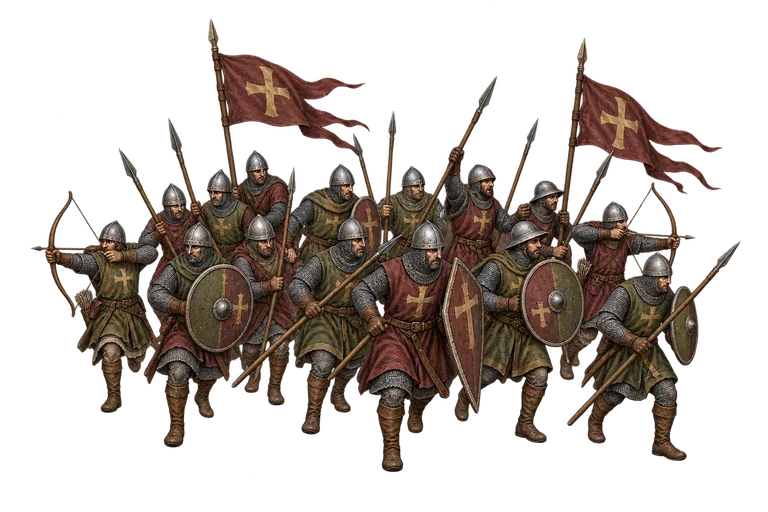

Production
City growth improves long-term output. Balance upgrades with enough troops and wall strength to hold the value you create.
Learn how city growth, production, walls, scouting, and troop positioning shape a campaign. A stronger plan starts with understanding what your army must overcome.
Updated September 27, 2026. Your attacker King Power determines when weaker-kingdom protection applies to attacks on regular cities. Divide your King Power by the defender's King Power to find the ratio.
| Attacker King Power | Capped assault begins | Raid-only begins |
|---|---|---|
| 1M or less | 3× | 4× |
| 10M | 2.75× | 3.5× |
| 100M | 2.5× | 3× |
| 1B and above | 2× | 2.5× |
These are milestones on a continuous curve. Thresholds tighten smoothly between them on a logarithmic power scale, so passing 10M or 100M does not create a sudden jump. Reaching a threshold enters the more protected mode.
Example: a 100M attacker against a 50M defender has a 2× ratio, so normal combat applies. Against a 40M defender, the ratio is exactly 2.5× and capped assaults begin. Against a 25M defender, the ratio is 4× and only raids are allowed.
Main City protection, shields, clan restrictions, and other eligibility rules still apply. Check the in-game attack preview for your exact powers and target.
Regular cities, including Main Cities, use the October troop-production increase. Base examples are 162 troops/hour at Level 1, 19,034 at Level 100 and 45,436 at Level 200, before bonuses or account-specific adjustments. See the current wall and production table below.
Newly calculated routes have 10% shorter base travel time. Army size, order type, skills, gear, objectives, and applicable items still affect the final duration. The 30-second army and 10-second scout minimums still apply; marches already accepted keep their recorded arrival times.
City growth improves long-term output. Balance upgrades with enough troops and wall strength to hold the value you create.
Scout shortly before a march. Reports are snapshots, while defenders can reinforce and conditions can change before arrival.
Troops remain in the city that trained them until moved. A strong kingdom can still expose a frontier by concentrating forces elsewhere.
An attack must first overcome the current wall and then defeat the live garrison. Use in-game reports and previews for current values; a scout-time preview is not a guarantee that arrival-time defenses will remain unchanged.
Common mistake: Equal remaining attack and defense does not capture the city.
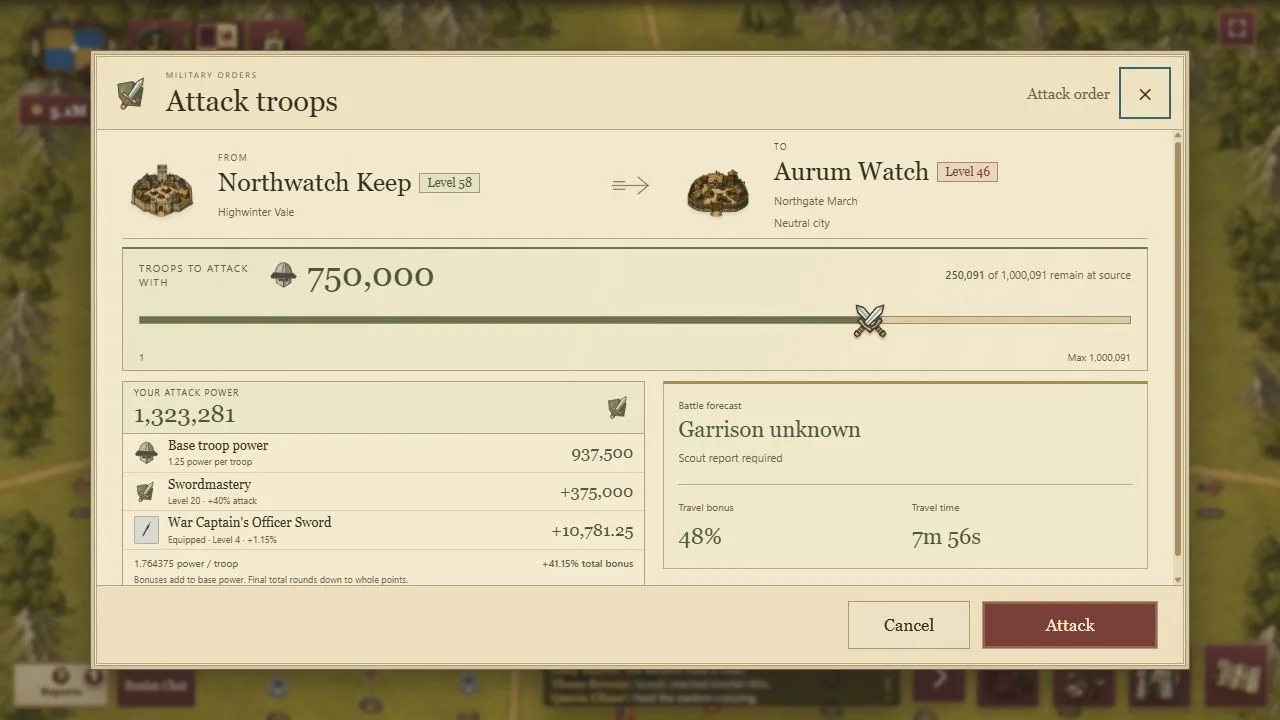
Select the image, then choose View full size to inspect details. Scroll or swipe inside the enlarged image.
If one ruler takes a regular neutral city and another ruler captures it from that claimant within 20 minutes, the server records one directional handoff across all maps. The fourth event in a rolling 24 hours warns both rulers, the seventh gives a final warning, and an eighth qualifying capture is canceled until a slot opens. Failed attacks, duplicate claim events, established cities, and objectives do not count; normal combat remains available. Each notice shows the trigger and next slot, with questions or appeals directed to Support.
A Royal Peace Shield lasts 12 hours. Only your regular cities with walls at 100% receive its protection. A damaged city gains protection automatically when repairs finish, provided you still own it and your Shield is still active. Repair does not restart the Shield timer. Attacks still travelling when repair finishes are checked again at arrival.
A qualifying player-initiated PvP dispatch starts a 15-minute Peace Shield activation cooldown. Another qualifying dispatch restarts it. Defending, scouting, friendly transfers, and attacks on neutral objectives do not start this cooldown.
When a protected weaker ruler captures a stronger ruler's regular city, the displaced ruler can receive a single-use 24-hour retaliation authorization for that exact city. It lifts the relevant King Power attack limit for that target; other protection rules still apply. Use the timer card's Map action to find the recorded location. Merely viewing it does not spend the authorization. A successful launch before expiry remains authorized throughout travel. A successful dispatch spends the opportunity immediately, even if the attack loses, is recalled or turns back. Failed dispatches spend nothing. The capturer cannot abandon that city during the matching 24-hour window. Older grants keep their saved deadlines.
Before an order that would remove an active Peace Shield, review the confirmation showing the destination, troops and remaining Shield time. Cancel, close or Escape preserves the Shield and sends no troops; Continue sending rechecks the order before dispatch.
Protected Assault and Protected Raid rules remain distinct from ordinary capture combat. Read the current attack panel instead of assuming a large power advantage always permits a capture.
The October web balance gives regular cities a 25% higher base troop-production rate than the preceding release, before whole-troop rounding. City walls now sit between the earlier stronger curve and the short-lived five-stage curve through Level 100. Use these current reference values when planning a siege.
Swipe across the table to see every column.
| City level | Base wall power | Base troops per hour |
|---|---|---|
| 1 | 200 | 162 |
| 25 | 85,279 | 3,514 |
| 50 | 853,335 | 8,097 |
| 75 | 1,614,168 | 13,315 |
| 100 | 3,000,000 | 19,034 |
| 150 | 6,200,000 | 31,606 |
| 200 | 11,340,888 | 45,436 |
Stoneworks and eligible wall gear still apply to the base. Existing damage and repair deadlines carry forward. Objective walls keep their separate balance, and Camps have no walls. Above Level 150, walls use the fixed pre-increase production reference; raising troop production did not raise those walls by another 25%.
Production bonuses retain their existing rules. Existing temporary account-specific production adjustments can affect displayed rates and production-scaled rewards; your city panel is authoritative for your account. Gold production, upgrade prices and starting grants did not receive this troop increase. Already-claimed rewards are not recalculated.
For new attacks, attack strength, travel and casualty-recovery skills and equipped gear lock when the army departs. That includes Swordmastery, March Orders and Field Medics with their applicable equipment. Resetting points, swapping gear or upgrading a piece during travel cannot improve that army’s saved effects.
Each Rally contributor locks their own preparation when the combined army launches, not when they first join its assembly. Defenders and stationed reinforcements still use their live defensive and recovery effects at arrival. Eligible recovered casualties return to the owner’s current Main City. Older individual marches without saved departure recovery keep their prior fallback; completed reports keep their recorded results.
After leaving or being removed, the normal wait to join, apply to or create another clan is one hour. A disbanding Leader receives that wait; other members released by disbanding can join elsewhere immediately. Joining a clan begins a separate one-hour Tower participation probation, including Clan Shop buying.
For 24 hours after a qualifying departure, the clanmates present at departure may fight you but cannot capture your regular cities. A victory can still damage walls and cause casualties; the city keeps its owner, level and investment, and surviving attackers return. The restriction is checked at arrival. An attack arriving after it expires can capture under the usual rules.
This protection applies to those former clanmates, even if either side changes clans again. It does not block unrelated rulers or change objective rules. Retaliation does not bypass it. A one-hour joining cooldown is therefore different from the 24-hour capture restriction.